
GH Secretagogues Explained: CJC-1295, Ipamorelin & the GH-Axis in Research
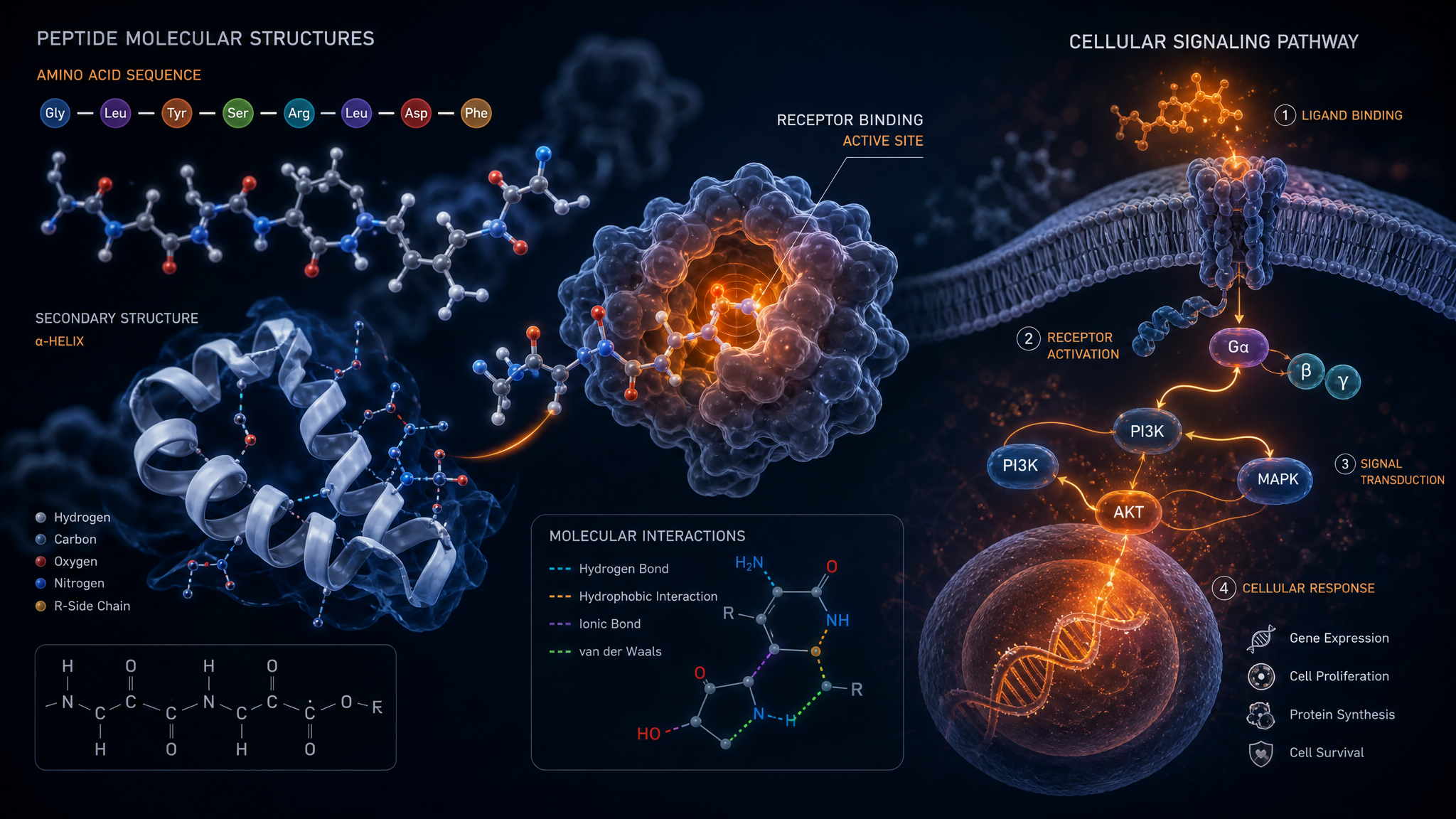
The growth-hormone axis (GH-axis) is one of the most extensively mapped signaling systems in endocrinology, which makes it a frequent subject of peptide research. GH secretagogues are compounds studied for their ability to modulate this axis, and they fall into two mechanistically distinct families.
The GH-axis in brief
Growth hormone release from the pituitary is governed by a balance of signals from the hypothalamus. Two of the most relevant for peptide research are growth-hormone-releasing hormone (GHRH), which stimulates GH secretion, and somatostatin, which inhibits it. A third pathway — the ghrelin receptor (GHSR) — provides an additional stimulatory input. Most research-grade secretagogues act on one of these two stimulatory routes.
Family 1: GHRH analogues
CJC-1295 and Sermorelin are studied as analogues of GHRH. Structurally, they are modified to resist enzymatic degradation, extending the window over which they interact with GHRH receptors in research models. CJC-1295 in particular is often referenced for its stabilized backbone, which is studied for a prolonged interaction profile compared with native GHRH.
Family 2: Ghrelin-receptor agonists (GHRPs)
Ipamorelin, GHRP-2, and GHRP-6 act on the ghrelin receptor rather than the GHRH receptor. Ipamorelin is frequently studied because it is regarded in the literature as a relatively selective ghrelin-receptor agonist, meaning it is investigated for its targeted activation profile within GH-axis research.
Why the two families are often studied together
Because GHRH analogues and ghrelin-receptor agonists act through different receptors, researchers frequently examine them in combination to study potential synergistic signaling. CJC-1295 paired with Ipamorelin is one of the most referenced combinations in GH-axis research literature, precisely because the two compounds engage complementary pathways.
Understanding which receptor a secretagogue targets is the first step in interpreting any GH-axis experiment.
A note on selectivity and interpretation
Selectivity matters because off-target receptor activity can complicate data interpretation. Compounds described as more selective are often preferred in mechanistic studies where isolating a single pathway is the goal. As always, the relevance of any finding depends on the model system, experimental concentration, and laboratory controls used.
Key takeaways
- GH secretagogues modulate the GH-axis through two main routes: GHRH receptors and the ghrelin receptor.
- CJC-1295 and Sermorelin are GHRH analogues; Ipamorelin and the GHRPs are ghrelin-receptor agonists.
- The two families are often studied together to explore complementary signaling.
- Receptor selectivity is central to clean experimental interpretation.
All products referenced are intended strictly for in-vitro laboratory and scientific research use only. Not for human consumption.
DISCLAIMER: This article is for educational and research reference purposes only. It does not constitute medical advice. All compounds mentioned are sold for laboratory research use only — not for human consumption. Consult published literature and institutional guidelines before initiating any research protocol.
EXPLORE OUR CATALOG
Browse 87+ research-grade peptide compounds with 99%+ verified purity.
VIEW ALL PEPTIDES